
Tata Electronics–Synopsys Chip Design Partnership: What It Means for Dholera

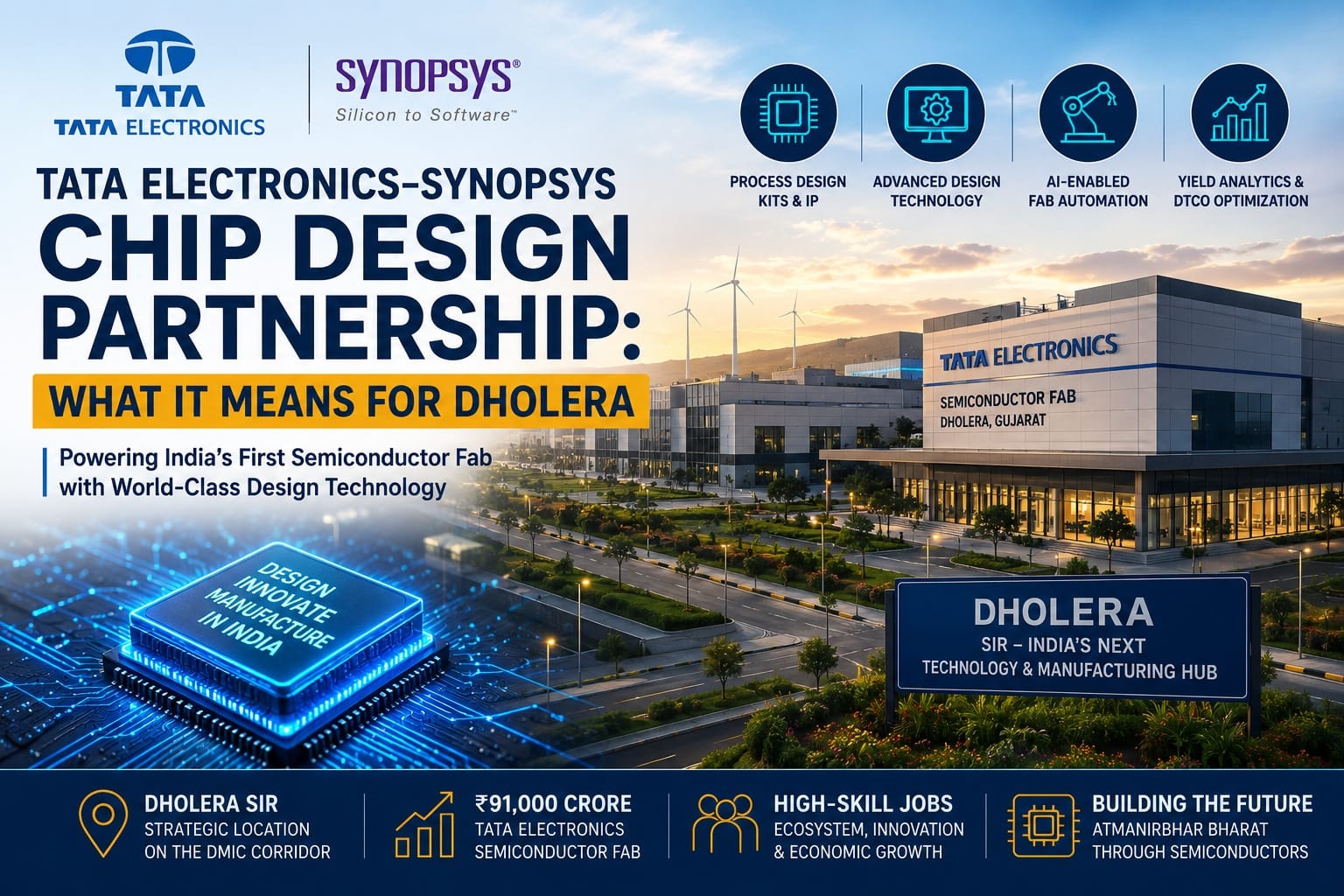
When people talk about the semiconductor story in Dholera, the conversation usually starts with the headline number: Tata Electronics' planned ₹91,000 crore semiconductor fabrication facility. But a semiconductor fab is not simply a large industrial building filled with manufacturing equipment. It requires an entire ecosystem of design tools, process technology, intellectual property, engineering expertise, data systems, equipment, materials and skilled talent.
That is why Tata Electronics' partnership with US-based semiconductor technology company Synopsys is important.
The agreement between Tata Electronics and Synopsys connects the planned Dholera semiconductor fab with specialised semiconductor design and manufacturing technologies. The collaboration covers areas including process technology bring-up, foundry design enablement, process design kits, intellectual property development, technology computer-aided design, factory automation, yield analytics and Design Technology Co-Optimisation.
For anyone following the broader Dholera Smart City development, this matters because it shows that the semiconductor project is being developed as part of a wider technology and industrial ecosystem rather than as an isolated manufacturing facility.
What Is the Tata Electronics–Synopsys Partnership?
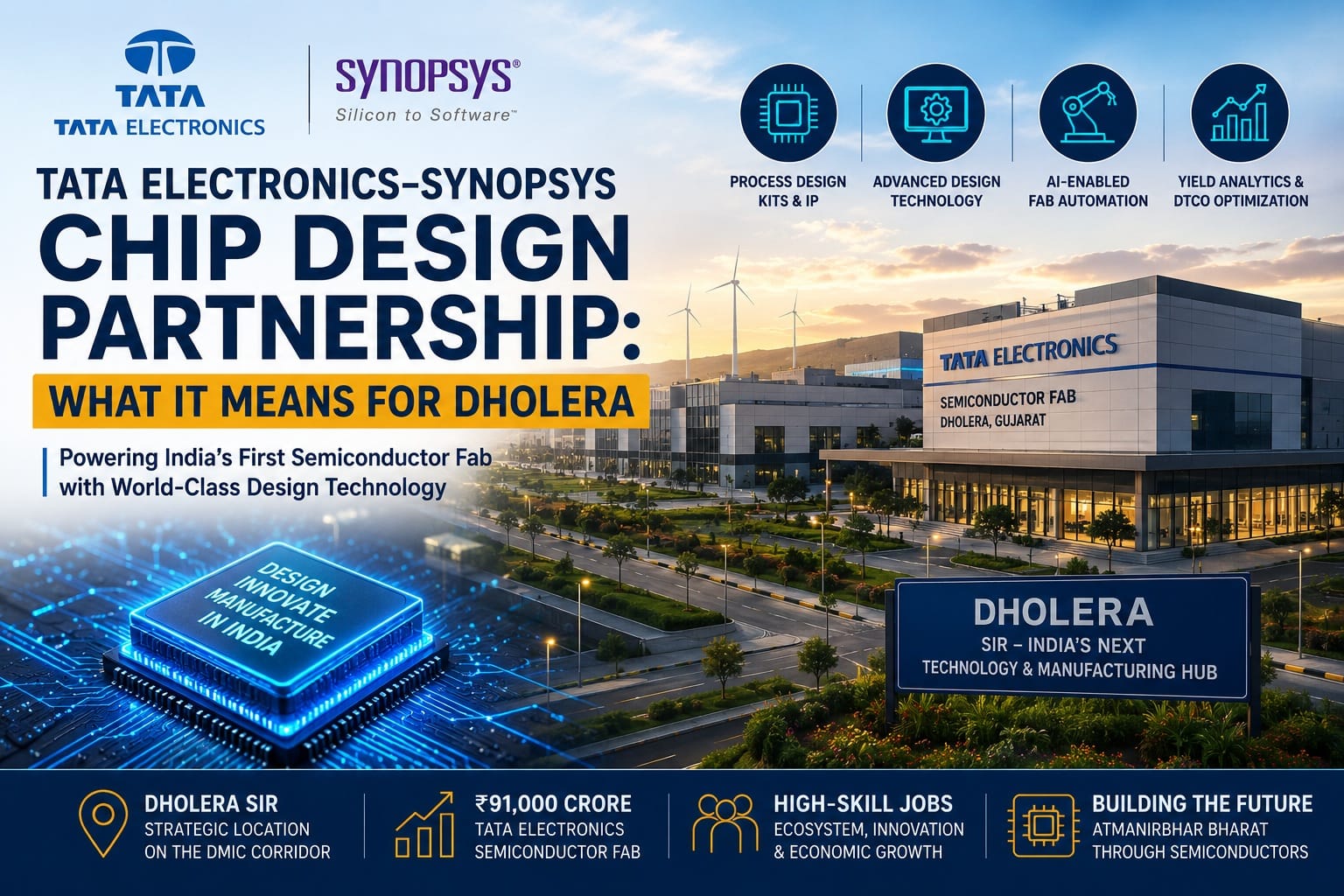
Synopsys is a major global provider of semiconductor design and electronic design automation technologies. Its role is fundamentally different from that of a company simply supplying physical manufacturing equipment.
A modern semiconductor ecosystem needs both the ability to design chips and the ability to manufacture them reliably at scale.
Tata Electronics is developing the manufacturing capability in Dholera, while technology partnerships such as the one with Synopsys help create the digital and engineering infrastructure required to take semiconductor designs toward manufacturing.
This relationship is important because it creates a bridge between chip designers and the planned Dholera foundry.
In practical terms, that can help position Dholera as more than a location where chips are physically manufactured. It can become part of a wider semiconductor value chain involving design, process development, manufacturing and supporting technology.
For readers tracking the region's industrial transformation, our broader Dholera Smart City provide additional context on how the region's infrastructure and development are evolving.
Why Does Chip Design Matter to a Semiconductor Fab?
A semiconductor fab cannot operate independently from the wider chip-design ecosystem.
Before a chip reaches a manufacturing line, engineers have to work through highly specialised stages involving design, simulation, verification and process development. The manufacturing process itself also has to be characterised, tested and stabilised.
One important component is the Process Design Kit (PDK).
A PDK provides semiconductor designers with the information and tools required to design chips that can actually be manufactured using a particular fabrication process.
This makes the Tata Electronics–Synopsys collaboration significant beyond the headline announcement. It helps establish the technical interface between semiconductor designers and the Dholera foundry.
That connection could become increasingly important as companies evaluate India as a destination for semiconductor manufacturing.
Dholera Is Being Built Into a Semiconductor Ecosystem
The Synopsys relationship is only one part of the larger semiconductor story.
Tata Electronics has announced collaborations and partnerships involving semiconductor technology, manufacturing equipment, materials, lithography, design and workforce development.
The Dholera fab is being developed with Powerchip Semiconductor Manufacturing Corporation (PSMC) of Taiwan, while other global technology relationships address different parts of the semiconductor manufacturing chain.
This is important because successful semiconductor manufacturing depends on an interconnected ecosystem.
A fab needs:
- Semiconductor equipment
- Process technology
- Design enablement
- Materials
- Engineering expertise
- Skilled workforce
- Supply-chain infrastructure
- Quality and testing capabilities
- Reliable utilities
- Logistics
- Technology partners
The more of these components that develop around Dholera, the more significant the region can become as an industrial technology destination. Our article on how Dholera is moving from its master plan toward real-world growth provides useful background on this broader transition.
The Bigger Dholera Smart City Connection
Dholera was conceived as a large-scale, master-planned development designed to accommodate industrial and urban growth. The semiconductor project fits naturally into that model because a large manufacturing facility requires supporting infrastructure on a scale that is difficult to create around an already-congested urban area.
The semiconductor fab therefore becomes more than an individual investment.
It can function as one of the major economic anchors within the broader Dholera development.
The important distinction is:
"Tata is building a semiconductor fab."
versus:
"A major semiconductor manufacturing ecosystem is being established within a master-planned industrial region."
The second statement captures the larger economic significance.
For a wider understanding of why Dholera was selected for large-scale development, see our analysis of why Dholera SIR was located here.
What Could This Mean for Dholera?

The economic impact of a semiconductor fab can extend beyond the physical boundary of the manufacturing facility.
A large semiconductor ecosystem can create demand for specialised suppliers, engineering services, logistics, industrial infrastructure, technology services, maintenance, workforce training and supporting businesses.
This is particularly relevant because Dholera is being developed as a large-scale industrial and urban region rather than a conventional standalone industrial estate.
The semiconductor fab can act as an anchor.
Around that anchor, suppliers, service providers, workers and supporting economic activity can gradually develop.
This potential multiplier effect is one reason infrastructure development and industrial investment should be viewed together when assessing Dholera.
Our article on how residential development around Dholera SIR is evolving explores the residential side of this broader development story.
Potential Impact on Employment and Skills
Another important effect could be the development of specialised technical talent.
Semiconductor manufacturing requires engineers and technicians with expertise across electronics, manufacturing, materials, process engineering, automation, data analytics and semiconductor design.
Tata Electronics has also been developing partnerships with academic and government institutions aimed at building semiconductor-related skills.
Over time, this could contribute to a broader talent ecosystem around Dholera.
For the region, that matters because skilled employment can create secondary demand for:
- Housing
- Transportation
- Education
- Retail
- Hospitality
- Healthcare
- Professional services
- Industrial support services
This is how a major industrial project can potentially influence the wider economic geography of a region.
What Does This Mean for Residential Development?
The connection between semiconductor manufacturing and residential real estate should be approached carefully.
A factory announcement does not automatically mean that every surrounding plot will appreciate or that residential demand will immediately surge.
The more useful question for a residential buyer is:
Is the surrounding economic ecosystem developing in a way that could create sustained demand for housing and supporting services over time?
The Tata Electronics–Synopsys relationship is one piece of evidence in that larger picture.
Anyone evaluating individual residential projects should still conduct project-level due diligence rather than relying solely on regional infrastructure announcements.
For example, buyers researching residential projects in the Dholera region can explore Sidhi 857 residential plots in Bhangadh as an example of how individual developments should be assessed separately from the broader Dholera infrastructure narrative.
The regional growth story and the individual plot decision are related—but they are not the same thing.
Why the Synopsys Partnership Adds Credibility
The importance of the partnership also comes from the type of company involved.
Synopsys is not a conventional real-estate or generic technology company. Its expertise is closely connected to semiconductor design and electronic design automation.
Its involvement therefore demonstrates that the Dholera manufacturing project is being connected to specialised global semiconductor technology infrastructure.
That is a meaningful distinction.
A generic infrastructure announcement tells us that something may be built.
A partnership with a specialised semiconductor technology company tells us something about how the planned manufacturing ecosystem is being assembled.
This is why the Synopsys relationship deserves attention when analysing the Dholera semiconductor story.
How the Semiconductor Project Fits Into Dholera's Larger Growth Story
The semiconductor project should not be viewed in isolation.
It sits alongside:
- Industrial infrastructure
- Road connectivity
- Airport development
- Planned rail connectivity
- Utilities
- Technology investment
- Manufacturing projects
- Skill-development initiatives
- Residential development
This combination is what makes Dholera's development story different from a conventional industrial project.
Our guide on why Dholera is trending again in 2026 looks at the broader factors contributing to renewed attention around the region.
Likewise, the Ahmedabad–Dholera semi-high-speed corridor analysis provides additional context on the connectivity side of the development story.
Why This Matters for Buyers and Investors
For someone researching Dholera residential plots, the semiconductor project is best understood as a long-term economic driver, not as a guaranteed property-return mechanism.
Infrastructure and industrial investment can improve the fundamentals of an emerging region, but the impact on individual properties depends on many variables.
These include:
- Exact location
- Legal status
- Planning status
- Connectivity
- Existing development
- Actual employment generation
- Nearby social infrastructure
- Residential demand
- Project execution
- Land title and documentation
- Buyer demand at the time of resale
This is why buyers should combine regional research with plot-level due diligence.
Our Dholera plot-buying guidance covers some of the practical issues buyers should consider before purchasing land in the region.
The Larger Picture
The Tata Electronics–Synopsys collaboration represents one piece of a much larger transformation.
Dholera's semiconductor ambitions involve multiple layers of the technology ecosystem: manufacturing, process technology, equipment, design enablement, engineering, workforce development and supply-chain infrastructure.
That means the region's long-term story is increasingly about ecosystem formation, rather than simply the construction of one large factory.
If these individual components connect successfully, the semiconductor fab could become one of the major economic anchors around which supporting industries and services develop.
That is potentially significant for Dholera because the region was designed from the beginning to accommodate large-scale industrial development.
What It Means for Dholera Going Forward
The Tata Electronics–Synopsys partnership does not guarantee a particular property return, nor does it mean that every part of Dholera will develop at the same pace.
What it does demonstrate is that Dholera's semiconductor project is being connected to specialised global technology capabilities.
That is an important development signal.
The bigger question is whether these individual investments eventually connect into a functioning technology and manufacturing ecosystem.
If they do, Dholera could gradually move from being primarily an infrastructure-led development story toward becoming a genuine technology and manufacturing hub.
For readers following the region's investment and development story, the Dholera Estates residential plots resource provides another perspective on how residential development is being positioned within the wider regional transformation.
Frequently Asked Questions
What is the Tata Electronics–Synopsys partnership?
Tata Electronics and Synopsys announced a collaboration covering semiconductor process technology bring-up and foundry design enablement for Tata Electronics' semiconductor fab in Dholera, Gujarat.
Is Synopsys building the semiconductor fab in Dholera?
No. Tata Electronics is developing the semiconductor fab. Synopsys is a technology partner supporting semiconductor design and process-related capabilities.
How much is Tata Electronics investing in the Dholera fab?
Tata Electronics has announced a planned investment of approximately ₹91,000 crore for the semiconductor fab.
Why is the Synopsys partnership important for Dholera?
It connects the planned Dholera manufacturing facility with specialised semiconductor design and foundry technologies, strengthening the broader ecosystem required for semiconductor manufacturing.
Will the semiconductor fab automatically increase residential plot prices?
No. A major industrial project can influence regional economic activity, but it does not guarantee appreciation for individual properties. Buyers should separately evaluate location, approvals, documentation, infrastructure, demand and project-specific fundamentals.
Where can I research Dholera residential plots?
The Dholera Smart City Plot provides information and resources related to residential plots and development in the Dholera region.
Conclusion
The Tata Electronics–Synopsys partnership adds another important layer to the Dholera story.
The semiconductor project is not being developed as a standalone factory. It is being connected to global semiconductor design, manufacturing, equipment and technology ecosystems.
For Dholera Smart City, that distinction matters.
The region's long-term potential depends not on one announcement but on whether multiple investments gradually connect into a functioning industrial ecosystem.
The Synopsys partnership is one of those connections—linking semiconductor design technology with the manufacturing capability being developed in Dholera.
And as Tata Electronics continues developing relationships across the semiconductor value chain, the more important question may no longer be whether Dholera will have a semiconductor fab.
It is whether that fab can become an anchor around which an entire technology and manufacturing ecosystem develops.
That is the development story worth watching.