
Dholera Smart City Infrastructure: Current Status and Future Development

Introduction
Infrastructure is one of the most important factors determining whether a planned city can develop into a functioning industrial and urban centre. Roads, electricity, water supply, drainage, transport facilities, industrial utilities and public services must work together to support businesses and communities.
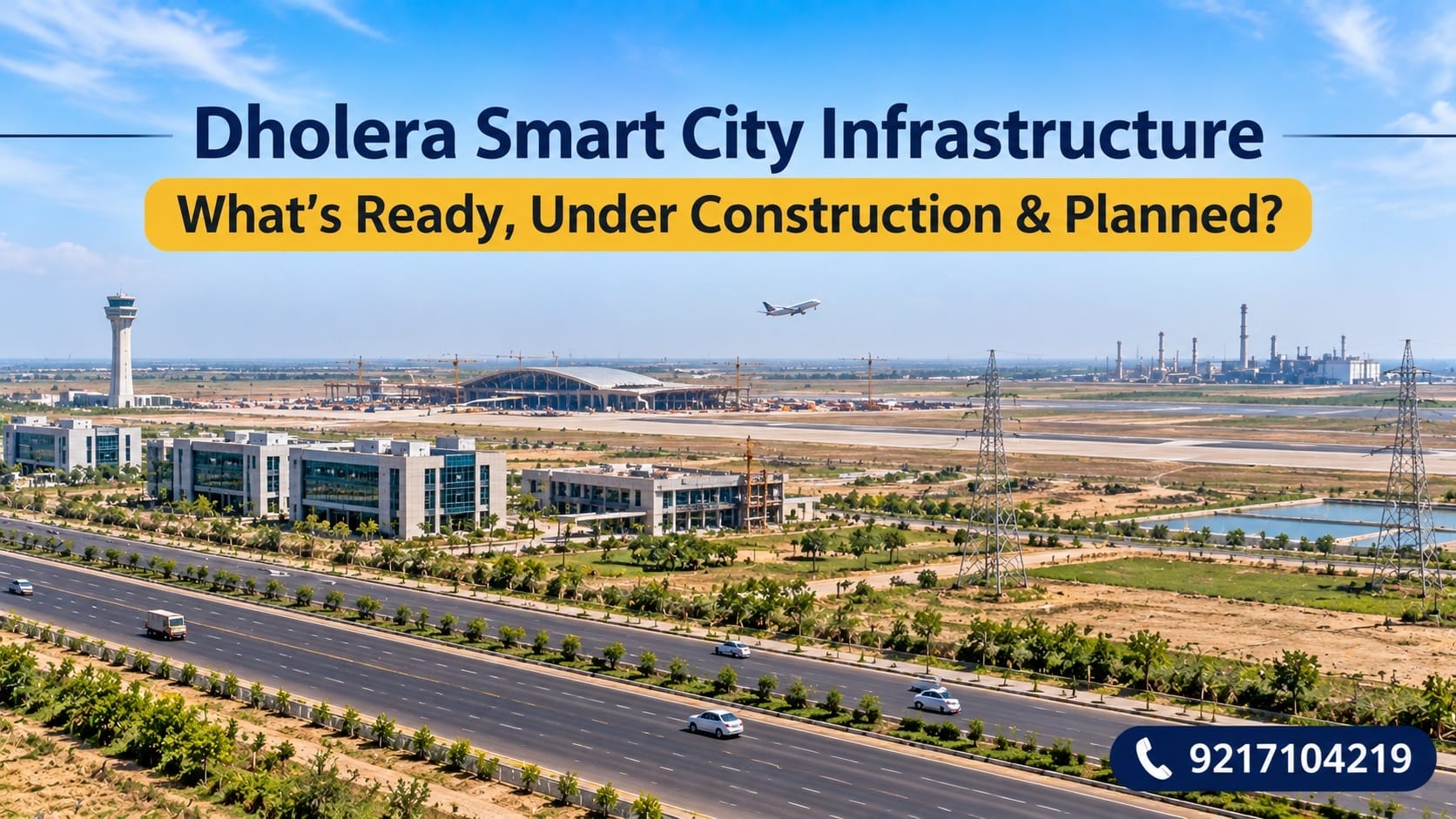
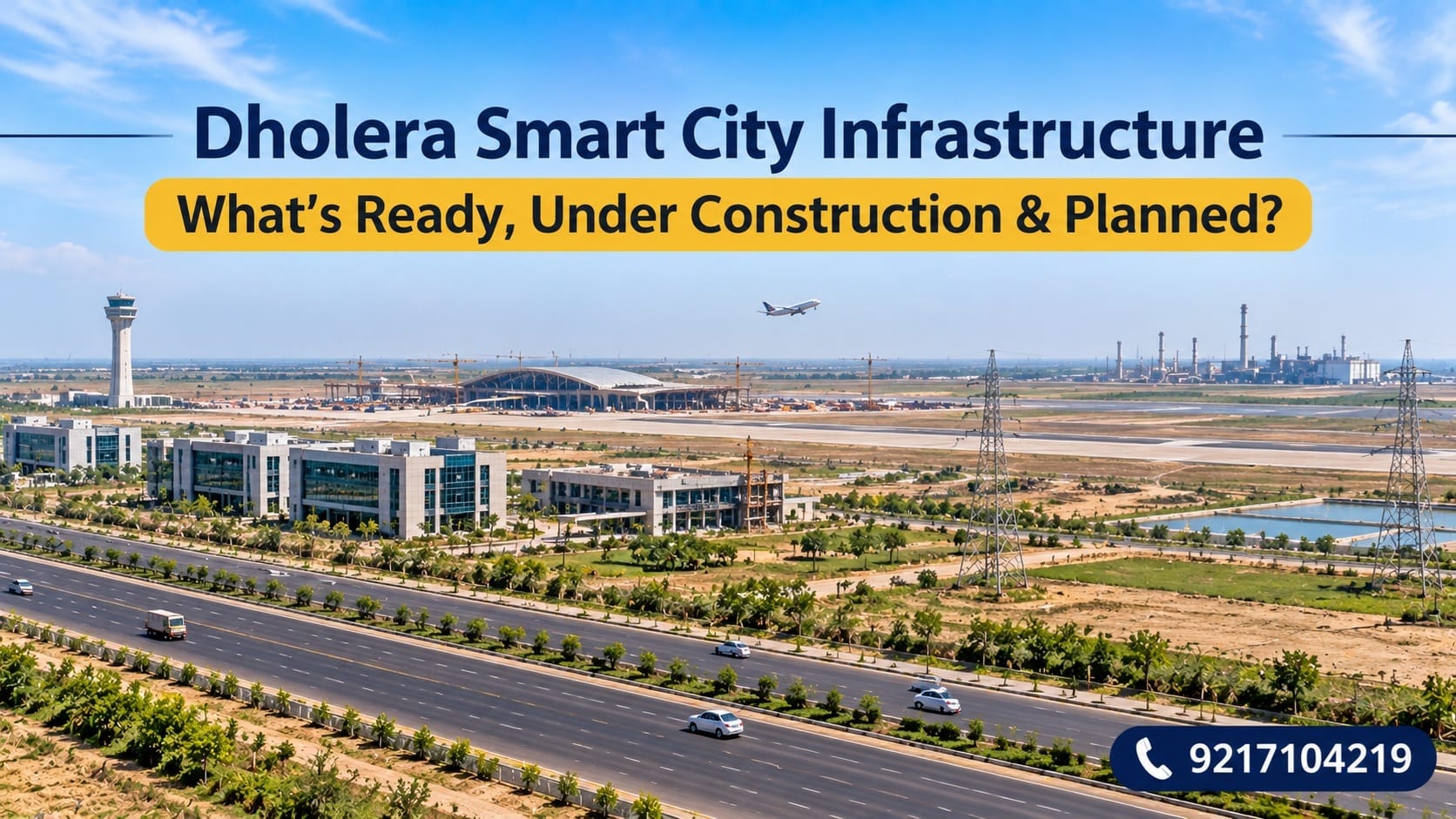
Dholera Smart City Project in Gujarat is being developed with this integrated approach. Its long-term vision includes industrial manufacturing, logistics, residential areas, commercial activities and supporting urban infrastructure.
However, understanding Dholera's progress requires more than reading infrastructure announcements. Different projects are at different stages. Some facilities have reached important operational milestones, some are under construction, while others have received approvals but still require implementation.
For anyone researching Dholera, the important question is not simply how much infrastructure has been announced. It is what is ready today, what is being developed and what still needs to be delivered?
1. Understanding Dholera's Infrastructure Development Model
Dholera Special Investment Region (SIR) is a planned industrial and urban region covering approximately 920 square kilometres across 22 villages.
Its development is being implemented in phases rather than through simultaneous construction across the entire region.
An important part of this strategy is the Activation Area, which covers approximately 22.5 square kilometres. It was identified to concentrate initial infrastructure development and create a foundation for subsequent industrial and urban activity.
The Department for Promotion of Industry and Internal Trade (DPIIT) reported in its June 2026 monitoring document that the Activation Area's trunk infrastructure works were complete.
This is an important milestone, but it should be interpreted correctly. Completion of trunk infrastructure in a defined area does not mean that every building, factory, residential facility or public service across the wider Dholera region is operational.
The distinction between regional planning, trunk infrastructure and individual project readiness is essential when evaluating Dholera.
2. Road Infrastructure: Ahmedabad–Dholera Expressway
Road connectivity is one of the most visible infrastructure developments associated with Dholera. The Ahmedabad–Dholera Greenfield Expressway extends approximately 109 kilometres and is designed to improve access between Ahmedabad and the Dholera region.
The Ministry of Road Transport and Highways described the expressway's development and connectivity benefits in its February 2026 update. The corridor subsequently reached a major inauguration milestone on 31 March 2026.
For industrial businesses, improved road connectivity can support the movement of:
- Raw materials and manufacturing inputs
- Industrial machinery and equipment
- Finished products
- Employees and technical professionals
- Logistics vehicles and commercial transport
The expressway is also relevant to property buyers and business visitors travelling between Ahmedabad and Dholera.
However, access to the expressway should not be confused with direct access to every industrial or residential location. The actual approach road, entry point, travel distance and local road conditions must be assessed separately.
Current assessment: The expressway has reached an operational milestone. Local connectivity and access to individual destinations still need location-specific evaluation.
3. Dholera International Airport: Construction Versus Operational Readiness
Dholera International Airport is planned as a major component of the region's long-term transport infrastructure. It is expected to support passenger connectivity and potentially cargo movement associated with the developing industrial ecosystem.
During a review on 14 July 2026, the Ministry of Civil Aviation reported that approximately 80% of overall airport construction had been completed. The primary runway, taxiway and ATC tower were reported as complete, while work on the passenger terminal was progressing.
The airport plan also includes:
- A passenger terminal designed for approximately two million passengers annually
- A dedicated cargo terminal of approximately 2,500 square metres
- Supporting aviation and airport infrastructure
These facilities are intended to serve the wider industrial and economic development strategy.
However, physical construction and commercial airport operations are at different stages. An airport must meet the relevant safety, licensing, testing and commissioning requirements before scheduled commercial operations can begin. As of the November 2026 information reviewed for this article, the airport was still awaiting operational readiness, with an end-of-2026 target reported by government sources.
Current assessment: Major construction milestones have been achieved, but the airport should not be described as fully operational until the required regulatory clearance and commercial operations are confirmed.
4. Rail Connectivity: An Important Project Still to Be Implemented
Rail infrastructure is another important part of Dholera's planned multimodal connectivity. On 13 May 2026, the Union Cabinet approved the Ahmedabad (Sarkhej)–Dholera semi-high-speed double-line railway project.
According to the Ministry of Railways, the project includes:
- Approximately 134 kilometres of railway corridor
- Estimated project cost of ₹20,667 crore
- A stated completion target of 2030–31
The approved connection is intended to improve passenger movement between Ahmedabad and Dholera SIR, with connectivity associated with the upcoming airport and Lothal National Maritime Heritage Complex. Wider logistics network also includes the Bhimnath–Dholera Logistic Hub rail connection, which is relevant to freight movement and industrial supply chains.
These railway projects could become important components of the region's transport ecosystem. However, approval is not the same as construction completion or passenger and freight services becoming available.
For businesses planning long-term operations, rail connectivity may influence logistics planning. For property buyers, the actual location of stations, final routes and local access arrangements will matter more than general proximity claims.
Current assessment: The semi-high-speed rail project has received Cabinet approval. Its stated completion target is 2030–31, so it should be treated as a future connectivity project rather than an operational service.
5. Electricity and Industrial Utility Infrastructure
Reliable electricity is essential for manufacturing, particularly for industries that depend on continuous production, specialised machinery and sensitive equipment. Dholera's industrial development strategy includes power infrastructure designed to support manufacturing and related activities. DPIIT monitoring report of June 2026 also recorded that 300 MW of the planned 1,000 MW solar park capacity had been commissioned.
Electricity infrastructure is important for several reasons:
- Supporting industrial production
- Reducing interruptions to business operations
- Supporting technology-intensive manufacturing
- Providing power for urban services
- Strengthening the region's wider energy ecosystem
However, the presence of a regional power project does not automatically confirm the availability of a specific electricity connection at every plot or industrial parcel. Businesses should verify the sanctioned load, connection arrangements, distribution infrastructure and applicable supply conditions for their proposed location.
Current assessment: Solar generation has reached a reported commissioning milestone, while site-specific power availability must be independently confirmed.
6. Water Supply, Wastewater and Drainage: Essential for Long-Term Growth
Industrial facilities may require water for production, cooling, cleaning, processing and other operational activities. Residential and commercial areas also require dependable water supply and wastewater services.
A properly functioning urban system needs several connected components:
- Raw water sourcing and storage
- Water treatment and distribution
- Industrial water supply
- Wastewater collection and treatment
- Stormwater drainage
- Reuse and recycling systems
These services are just as important as roads and transport infrastructure. A factory may have access to a road and electricity, but its operational feasibility can still depend on water availability and wastewater management.
The actual capacity, commissioning schedule and service coverage of individual water and drainage systems should therefore be checked through official project documents and relevant authorities. It would be inaccurate to assume that every proposed utility facility is already available throughout Dholera.
Current assessment: Utility infrastructure is a central part of Dholera's planning framework, but the readiness and capacity of individual services should be assessed by location and project.
7. Social Infrastructure: Making Dholera Suitable for Everyday Life
An industrial city cannot function only as a place where people report to work. Employees, professionals, business visitors and families require healthcare, education, accommodation, food facilities and emergency services. The October 2026 government review of Dholera's social infrastructure included:
- A proposed 200-bed multispecialty hospital
- An integrated school
- A fire station
- A 42-room guesthouse
- A food court designed for approximately 600 people
- A tent city with 50 tents
- Hotel and residential development
These facilities are intended to support the growing industrial and urban ecosystem. Their status varies. Some facilities have been reported as complete, while others remain under construction or require operational arrangements and approvals.
For a detailed breakdown, read Omana Projects' Dholera social infrastructure status report. The availability of these facilities will influence how practical Dholera becomes as a place to work and live.
Current assessment: Social infrastructure is progressing, but the actual operating status, service capacity and accessibility of each facility should be confirmed separately.
8. How Should Buyers and Businesses Evaluate Infrastructure Readiness?
Infrastructure announcements can help people understand the direction of a developing region, but they should not replace practical due diligence.
Before evaluating a location in or around Dholera, consider the following questions.
1. Is the infrastructure operational?
Find out whether a road, utility, airport or other facility is currently available or only planned.
2. Is there direct access?
Check the actual route from the property or business location to the relevant infrastructure.
3. Are utilities available at the site?
Confirm electricity, water, drainage and other service arrangements rather than relying on regional development claims.
4. What is the applicable land-use status?
Industrial, residential, commercial and logistics activities may require different permissions.
5. Is the property inside the notified SIR boundary?
A property located in the wider Dholera region is not automatically within the notified Dholera SIR boundary.
6. Are the project details independently verifiable?
Review relevant government records, project approvals, title documents and applicable registration information.
For a practical property verification process, read Things to Check Before Buying a Property in Dholera.
9. What Will Determine the Next Phase of Dholera's Development?
Dholera's next phase will depend on how effectively its infrastructure components work together. Important indicators to monitor include:
- Regulatory clearance and operational commencement of the airport
- Construction and commissioning of the approved railway corridor
- Expansion of industrial power and utility capacity
- Reliable water supply and wastewater infrastructure
- Operational readiness of hospitals, schools and hospitality facilities
- Actual commencement of industrial manufacturing
- Development of local transport and supporting urban services
For example, an operational airport has greater value when businesses can reach it through reliable road connections. Industrial investment becomes more sustainable when electricity, water, logistics and workforce facilities are available. Residential development becomes more practical when healthcare, education and daily services are accessible.
The success of Dholera's infrastructure strategy will therefore depend not only on individual project completion but also on how effectively these facilities function together.
Frequently Asked Questions
1. What is the current status of Dholera Smart City infrastructure?
Dholera has achieved important milestones in its Activation Area trunk infrastructure and road connectivity. Other projects, including the airport, rail network and social facilities, are at different stages of implementation.
2. Is the Ahmedabad–Dholera Expressway operational?
The expressway reached its inauguration milestone on 31 March 2026. It is an important road connection for the Dholera region.
3. Is Dholera International Airport operational?
The airport had not yet reached confirmed commercial operational status in the November 2026 information reviewed for this article. Its end-of-2026 opening was a reported target, not a confirmed operational date.
4. When will the Ahmedabad–Dholera railway be completed?
The Ministry of Railways stated a 2030–31 completion target for the approximately 134-kilometre semi-high-speed rail project approved in May 2026.
5. Is all of Dholera SIR fully developed?
No. Dholera is being developed in phases. Completion of infrastructure in the Activation Area does not mean that the entire 920-square-kilometre region has reached the same development stage.
Conclusion
Dholera Smart City infrastructure is progressing through a combination of completed facilities, ongoing construction and long-term development projects.
The Ahmedabad–Dholera Expressway and Activation Area trunk infrastructure represent important milestones. The airport, approved railway corridor, industrial utilities and social facilities are also important components of the region's development strategy, although their readiness varies.
For businesses, the priority should be to assess whether the required infrastructure is available for their actual operations. For property buyers, it is equally important to verify the exact location, land-use permissions, legal documentation and existing access.
The most reliable way to understand Dholera is to separate what is operational from what is under construction and what remains planned.
Explore Dholera's property portfolio and regional development insights with Omana Projects or contact the team at +91 9217104219